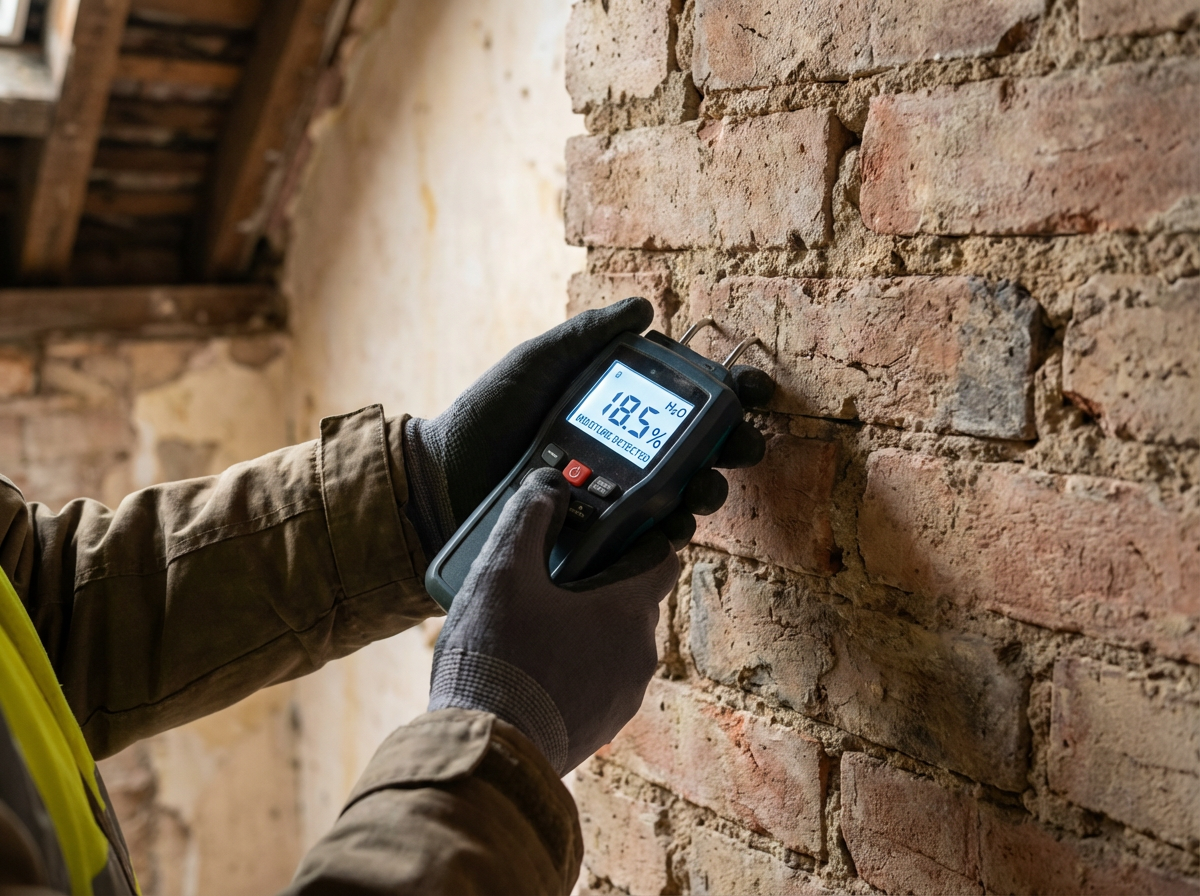
I've surveyed hundreds of properties throughout Barking and Dagenham over the years, and if there's one issue I find more than any other in the Victorian and Edwardian stock, it's damp. Rising damp in particular. It's common, it's often disguised, and if you don't know what you're looking at, it's very easy to miss — especially during a brief house viewing.
This guide is for buyers in Barking who want to understand what rising damp actually is, how to spot it at a viewing, and what to do if your surveyor flags it in a report.
What Is Rising Damp?
Rising damp is moisture that travels upward through the fabric of a wall from the ground. It's drawn up by capillary action — the same physical phenomenon that makes water climb a paper towel. In older buildings, a physical or chemical damp proof course (DPC) was either never installed, or has failed over time. Without a working DPC, groundwater migrates upward through brick and mortar.
True rising damp typically affects only the lower portion of walls — usually the first metre to metre and a half above floor level. Above that, the weight of the masonry creates enough resistance that the water can't rise further. This is one of the diagnostic clues surveyors use to distinguish rising damp from other types of moisture.
How Widespread Is It in Barking?
Very. The London Borough of Barking and Dagenham has a large stock of Victorian and Edwardian terraced housing — much of it built between 1880 and 1910. Many of these properties were built with a simple slate DPC, which can crack, bridge, or fail over 100+ years. Others had no DPC at all, relying on the thickness of their solid brick walls for moisture resistance.
Elevated external ground levels — a common issue in Barking's older streets, where decades of resurfacing have gradually raised pavement levels — make rising damp worse by bridging the DPC entirely. I've measured moisture levels in walls on some streets that are off the scale of a standard meter.
How to Spot It at a Viewing
You don't need a moisture meter to pick up warning signs. Here's what to look for during a property viewing:
- A tide mark or staining on lower walls — a horizontal band of discolouration, often brownish or yellowish, typically at knee height or lower.
- Peeling or bubbling plaster and paint — particularly near skirting boards and the lower sections of walls.
- Salts or efflorescence — white crystalline deposits on the wall surface. These are mineral salts left behind as moisture evaporates through the plaster.
- A musty smell — rising damp creates ideal conditions for mould growth. Trust your nose.
- Freshly painted or plastered lower walls — this can be a sign that a vendor has attempted to disguise a damp problem. Look for paint that's too fresh, or plaster that doesn't match the rest of the room.
- Lifted or replaced skirting boards — timber skirting boards are often the first thing to rot in rising damp conditions.
The Difference Between Rising Damp, Penetrating Damp, and Condensation
This matters — because the treatment and cost are very different for each.
- Rising damp affects lower walls only, has tide marks, and is associated with failed or missing DPCs. Treatment typically involves injection of a chemical DPC, re-plastering with salt-resistant render, and possibly raising airbricks or lowering external ground levels.
- Penetrating damp comes through walls, roofs, or around windows and doors — usually as a result of defective pointing, failed flashings, or leaking gutters. It can affect any part of the wall. Treatment involves fixing the defect and allowing the wall to dry out.
- Condensation is by far the most common form of moisture problem in UK homes. It's caused by warm, moist air meeting cold surfaces. It tends to be worse in winter, found in corners of rooms and on cold external walls, and associated with black mould (not to be confused with the grey-green mould of penetrating damp). Treatment is usually improved ventilation and heating patterns.
Many inexperienced surveyors — and virtually all untrained buyers — confuse these three. Getting it wrong means expensive and unnecessary treatment, or missing a real problem. This is why we spend time doing calibrated moisture readings rather than just visual inspection.
A Case Study: The Hidden Damp of Barking IG11
Last summer, I surveyed a Victorian mid-terrace that had recently been renovated to a high standard. Beautiful kitchen, new bathroom, fresh paint throughout. The estate agent was very proud of it.
But I noticed the skirting boards in the front reception room were slightly proud of the wall — as if they'd been re-fitted over new plaster. The lower walls had been freshly painted in a light grey that almost perfectly concealed a slight tide mark. My moisture meter told a different story: readings of 18–22% WME (wood moisture equivalent) in the base of the walls — well into the "damp" range.
The buyer used my report to have a specialist investigation carried out. It confirmed active rising damp in the front and rear ground floor walls, plus salt-contaminated plaster that would need full strip-back and replacement. Estimated cost: £8,500. The asking price came down accordingly.
What Happens If Your Survey Flags Damp?
It depends on the severity. A Condition 3 rating (urgent) means you should get a specialist contractor's quote before exchanging. Use that quote to renegotiate the price or ask the vendor to carry out the works. A Condition 2 rating (requires monitoring or maintenance) means you should budget for works but it's not a reason to walk away. We can advise on the likely cost range.
Don't panic at the first sight of the word "damp" in a survey report. In most cases it's manageable, treatable, and priceable. What matters is knowing about it.
Next Steps
If you're buying a Victorian or Edwardian property in Barking, Dagenham, or East London, our specialist damp and timber survey will give you a clear picture of what's going on below the paintwork. And if you'd like the reassurance of a full Level 3 building survey, we'll include calibrated damp readings as a matter of course.
Contact Barking Surveyors for a free, no-obligation quote. We typically arrange inspections within a week and deliver reports within 3–5 working days.
"I honestly had no idea there was so much damp behind those freshly painted walls. Sarah's report was incredibly detailed and gave us the confidence to renegotiate. Saved us a fortune." — Sophie M., Barking
Worried About Damp in Your Barking Property?
Our specialist damp surveys give you calibrated readings and clear advice — not vague estimates.
Book a Damp Survey