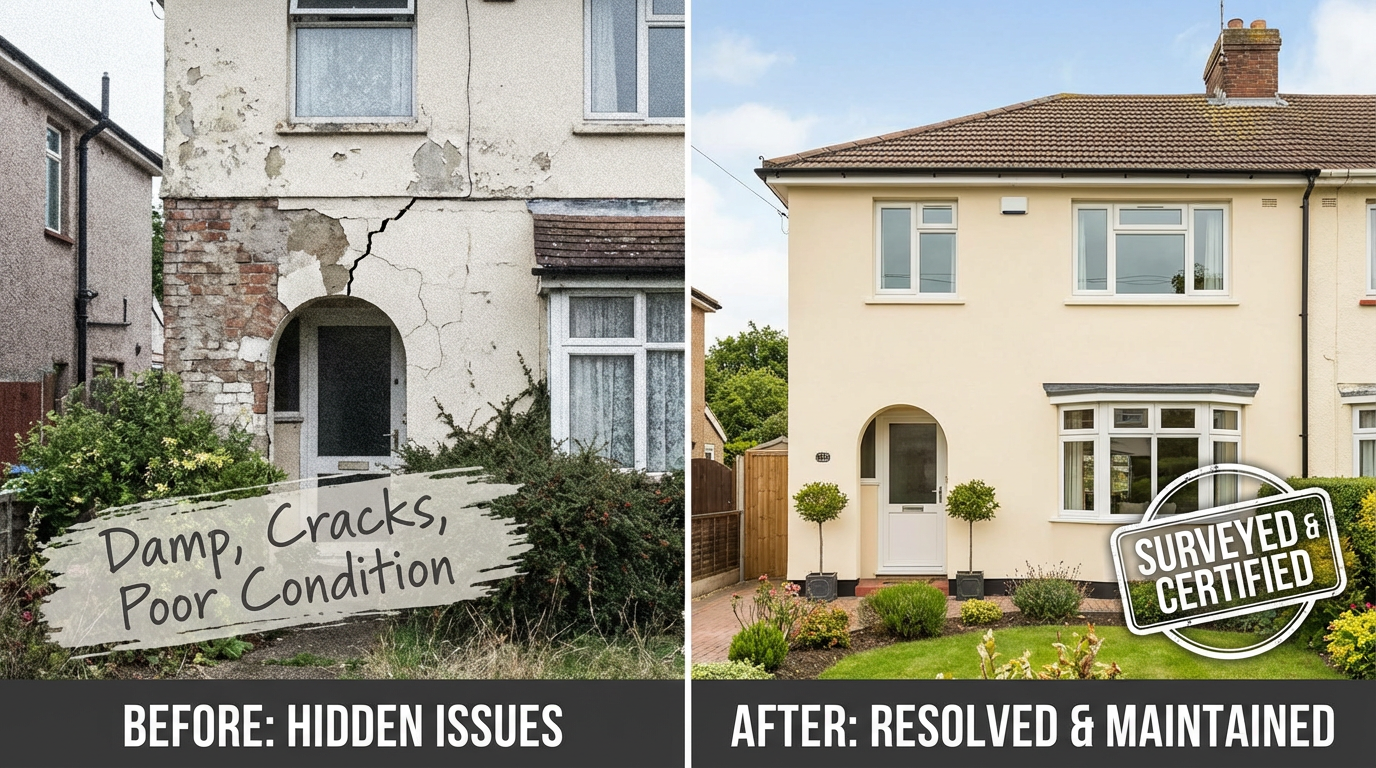
Your survey has come back with issues. Maybe there's damp. Maybe there are structural cracks. Maybe the roof needs replacing. Your first instinct might be to panic. Your second might be to call the estate agent and demand £15,000 off the asking price. Neither is the right move.
Here's how to approach renegotiation professionally, calmly, and effectively. I've helped hundreds of buyers in Barking and East London use their survey findings to save significant sums. Here's the approach that works.
Step 1: Read the Report Carefully
Before you do anything, read your survey report in full. Distinguish between:
- Condition 3 items (Red) — serious, urgent defects that require immediate attention or investigation. These are your strongest grounds for renegotiation.
- Condition 2 items (Amber) — defects that need attention but aren't urgent. These may support a modest price reduction or requests for vendor repairs.
- Condition 1 items (Green) — fine as they are. Don't use these in your negotiation — it will undermine your credibility.
Make a list of the Condition 3 and significant Condition 2 items. Call your surveyor to discuss them — we're always happy to clarify what's serious and what's not, and to give rough cost guidance.
Step 2: Get Contractor Quotes (Where Appropriate)
For the most significant defects — subsidence investigation, full re-roof, damp treatment, rewiring — it strengthens your position considerably to have actual contractor quotes. Contact two or three reputable local contractors for estimates. This takes a week or two but is well worth it for large items.
Your surveyor can often recommend suitable specialists in the area. We maintain a list of trusted contractors across Barking, Dagenham and East London.
Step 3: Prioritise What You're Going to Ask For
Don't try to renegotiate everything in the report. Focus on:
- The most expensive or urgent repairs (Condition 3)
- Items that will genuinely affect your ability to live in, or insure, the property
- Items that the vendor is unlikely to have disclosed and would be surprised by
Presenting a focused, well-evidenced list is far more effective than a shotgun approach where you list every minor issue. Vendors and their agents take selective, evidence-based requests seriously.
Step 4: Put It in Writing — Through the Estate Agent
All renegotiation should go through the estate agent, in writing. A simple letter or email works:
"Following our building survey, we have identified the following significant defects... [list them, with estimated costs]... In light of these findings, we would like to propose a revised offer of £X, or alternatively request that the following repairs be completed prior to exchange..."
Attach the relevant extracts from your survey report. Don't send the full report — it's not necessary and you're not obliged to. But referencing a RICS-accredited surveyor's findings carries weight.
Step 5: Know Your BATNA
BATNA stands for "Best Alternative to a Negotiated Agreement." In plain English: know what you'll do if the vendor says no. Will you walk away? Accept the current price? This is important to know before you enter the conversation.
In my experience, most vendors will move — at least partially — when presented with a professional survey report showing real defects and real costs. Vendors don't want to lose a buyer and start again. They know that if your deal falls through, the next buyer will likely get a survey too.
What Do Vendors Usually Agree To?
In our experience across Barking and East London, vendors typically agree to one of three things:
- A direct price reduction — often 50–80% of the estimated repair cost for serious defects
- Carrying out specific repairs before exchange or completion — common for smaller, clearly defined works
- A contribution to costs — a sum added to the deposit or held by solicitors until repairs are completed
Real Numbers From Barking
Here are some real (anonymised) outcomes from surveys we've completed recently:
- Victorian terrace, IG11: Rising damp + failed roof flashings. Estimated cost £12,000. Price reduced by £9,500.
- 1960s semi, RM10: Asbestos textured ceiling coatings + original fuse box. Estimated cost £4,500. Vendor agreed to £3,000 reduction and removal of asbestos before completion.
- New build flat, Barking Riverside: 60+ snags including fire stopping failure. Developer agreed to fix all items before completion. No price reduction needed — full remediation instead.
- Edwardian terrace, E6: Significant roof structure deflection. Estimated cost £18,000–£22,000. Price reduced by £15,000 after structural engineer's report obtained.
Book Your Survey and Protect Your Investment
Our reports give you the evidence you need to negotiate effectively. Fast turnaround. Local expertise. Fixed price.
Get a Free Quote